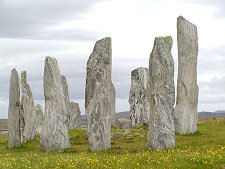
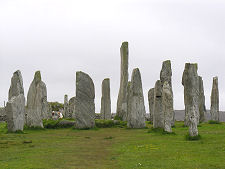
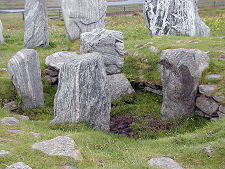
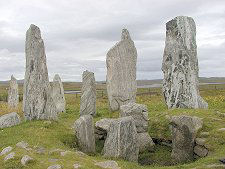
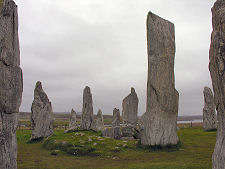
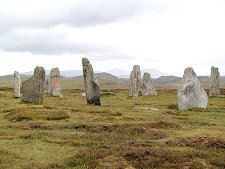
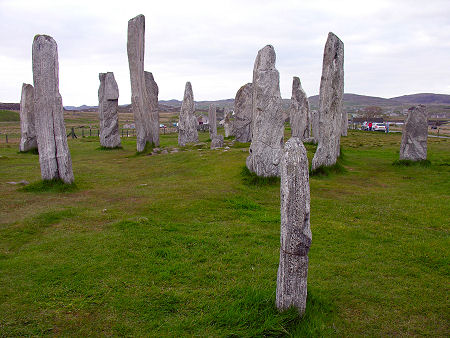
 Main Group at Calanais I |
Loch Roag is the sea loch that bites deeply into the north-west coast of Lewis, part of which envelops the island of Great Bernera. On the east shore of the loch the neck of a headland is home to the small linear settlement of Calanais, and, on a hump of land between the village and its jetty, the Calanais (or Callanish) Standing Stones.
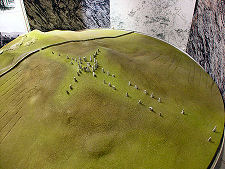
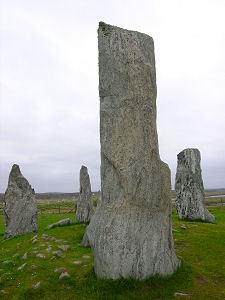
The area around Calanais is home to over 20 monuments erected between 3,000 and 4,000 years ago. Most famous by far is Calanais I, a complex arrangement of some 50 stones. At their heart is a circle of 13 stones between 8 and 13 feet tall, surrounding the tallest stone on the site, 16 feet high and weighing in at about 5.5 tonnes. Some time later a stone tomb was added to the centre of the circle.
Extending north from the main circle is an avenue formed by a double row of stones, while single rows of stones extend roughly east, west and south from the main circle.
It is thought that the alignments of the various stones were used to mark significant points in the lunar cycle. The stone circle and the north avenue were probably built before 2000BC, while the three single lines and the tomb added around 1500BC. (Continues below image...)
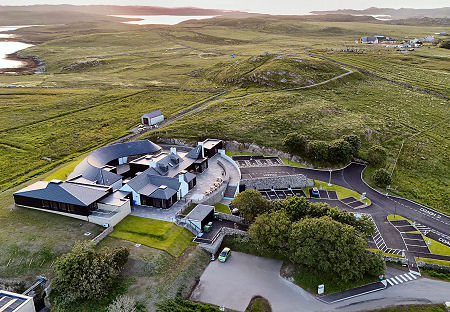 The Calanais Visitor Centre in 2026 after Refurbishment with the Stones in the Upper Right (All Visitor Centre Images Courtesy of calanais.org) |
The site had probably lost its special significance by about 800BC, when a small settlement was built close by. By then climate change had meant peat had been growing across the site for over 500 years and some of the stones were probably already out of sight. The peat was cleared from the site in 1857, by which time it was approaching 6 feet in depth.
Although of huge significance, the stones have not always been as well respected as you might expect. One of the stones at the end of the north avenue was broken in the 1860s. The missing tip was later found in a local wall and stuck back in place. Meanwhile a stray stone to the south-east of the main circle was set in concrete in the 1860s after being snapped off by a drunk waiting for a boat at the nearby pier.
A visit to Calanais is greatly enhanced by the Visitor Centre, opened during the 1990s on the hillside to the south. The centre is run by Urras nan Tursachan, The Standing Stones Trust, and reopened in 2026 after a major refurbishment. The stones themselves are in the care of Historic Environment Scotland. Entry to the centre, the gift shop, and the coffee shop is free; booking is required for the immersive exhibition and to see the stones. Opening times, booking, ticket information, and contact information can be found via the website linked from the Visitor Information section of this page. Note that although the Visitor Centre is not open on Sundays, the stones themselves are accessible every day
Such is the magnificence of the main collection of standing stones at Calanais I that other nearby monuments are too often overlooked. Just off the main road a little to the south-east of Calanais is "Calanais III", a collection of 20 stones forming a double ring with an outside diameter of 16m.
Because of the competing attractions of the main site, you are quite likely to have Calanais III to yourself. If you do you will be able to take in fully the stunning views, the remarkable atmosphere and the sound of nothing but the wind. A couple of hundred yards to its west is Calanais II, an 18m diameter circle comprising ten stones, of which five are still standing.
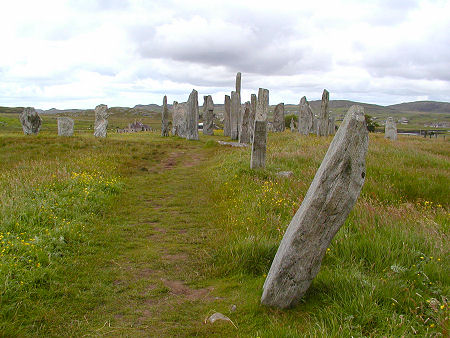 More of Calanais I |
|
|
|
Visitor Informationcalanais.orgView Location on Map Calanais, Isle of Lewis, HS2 9DY. Grid Ref: NB 213 330 What3Words Location: ///eased.regulator.reds |
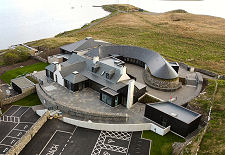 New Visitor Centre (All Visitor Centre Images Courtesy of calanais.org) |
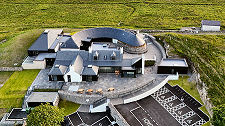 Another View |
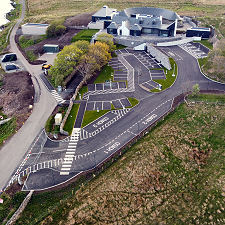 Visitor Centre and Car Park |
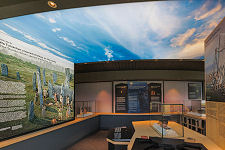 Inside the Visitor Centre |
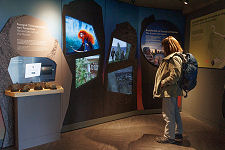 Inside the Visitor Centre |
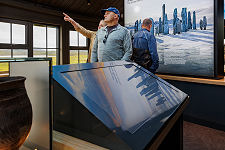 Inside the Visitor Centre |
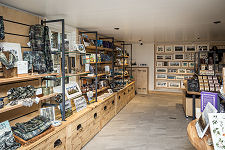 Visitor Centre Shop |
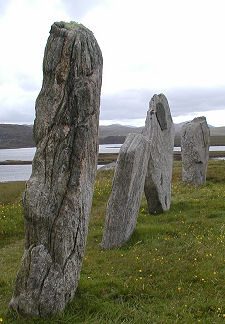 Four of the Stones |